 Yelp
Yelp Thumbtack
 Facebook
 Instagram
 Google Local Services Ads
01
Answer when nobody can
Calls that come in while you are on a job, on another line, or closed for the night get a helpful answer instead of a voicemail greeting.
AI answering service
An AI answering service answers your business calls 24/7 with a voice agent that knows your services, prices and service area. It collects what each caller needs, books the job when scheduling is on, and puts urgent callers through to you by the rules you write. With Auto-Respond it costs $10 a month per number plus $1 per minute of talk time.
7 days to try it Cancel anytime
You set the business information, response instructions, and scheduling options.
One platform. The channels you already use.
Keep doing what you do best
Let callers explain the job and get answers while your team is busy.
Calls that come in while you are on a job, on another line, or closed for the night get a helpful answer instead of a voicemail greeting.
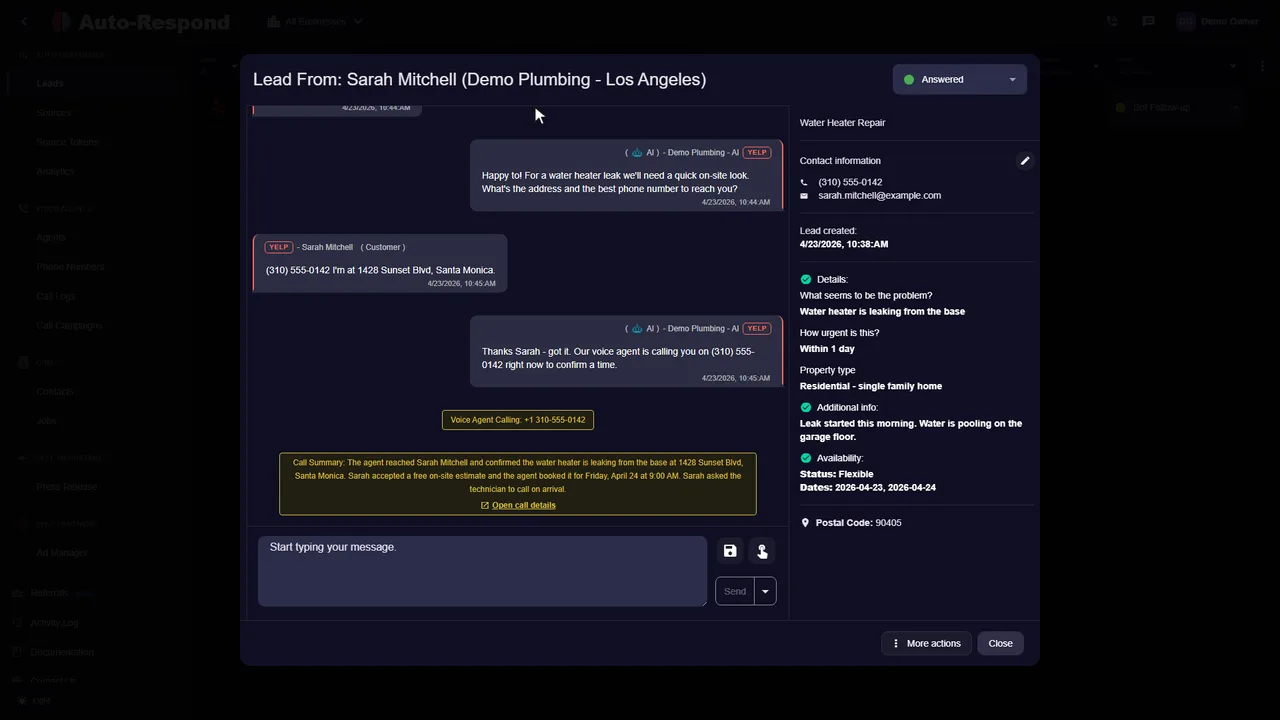
The service collects the caller's name, job details, location, and timing, and keeps a summary of every call.
Urgent or high-value calls can be transferred to your team under the rules you write, with a short private briefing first when you choose a warm transfer.
It does the job of the person who would answer your phone if you had one free: picks up, finds out what the caller needs, answers the questions it can, and moves the call to a next step. The difference from an answering machine is that the caller leaves with an answer or an appointment, not a promise of a callback.
Your greeting with your business name, a question about what they need, straight answers about your services, area, hours and the price ranges you approved, then an offer to book or a transfer to your team when the call meets your rules.
A call log with the recording, the transcript, an AI summary, the customer details it collected and any appointment it booked. Summaries can also go to your phone by SMS, to Slack or Telegram, or into your CRM.
Contractors miss calls for reasons an office never does: hands in a wall, on a ladder, driving between jobs, or on the line with the customer whose job is already booked. The caller who reaches voicemail often just dials the next company on the list. An AI answering service is built for exactly that gap, as long as you set it up for your trade rather than a generic office.
Three settings do most of the work: the transfer rules (which calls must reach a person now), the details the agent collects before booking, and your service area. A starting point by trade:
| Trade | Calls worth transferring | Details to collect before booking |
|---|---|---|
| Plumbing | Active leaks, no water, sewage backing up | Address, what is leaking or blocked, whether the water is shut off |
| HVAC | No heat or no cooling with vulnerable people at home, a gas smell | System type and age if known, the symptom, address |
| Electrical | Burning smell, sparking, power out to the whole home | Address, what stopped working, panel or outlet |
| Roofing | Water coming in during a storm | Address, repair or replacement, roof type, insurance claim or not |
| Cleaning, landscaping, moving | Rarely urgent; transfer a caller who insists on a person | Address, size of the job, preferred date |
Suggestions only: you write the transfer criteria in your own words, and the agent follows them.
Trade-by-trade setups are covered in our guides for plumbers, HVAC companies and roofing contractors.
A human answering service puts an operator from another company on your line. An AI answering service puts a voice agent on it that you configure yourself. Neither is better in every case; they are good at different calls.
| Human answering service | AI answering service (Auto-Respond) | |
|---|---|---|
| What it knows about your business | The script you send the provider | Your knowledge base: services, price ranges, service area, hours, policies |
| Typical outcome of a call | A message, or whatever the provider's plan includes | Answers, collected job details, and a booking when scheduling is on |
| Changing what callers hear | Ask the provider to update the script | Edit the greeting, instructions or knowledge base yourself |
| Urgent calls | Handled by the operator, per your instructions | Transferred by your written criteria, with a private briefing on a warm transfer |
| Message leads (Yelp, Thumbtack, Facebook, Instagram, Google LSA) | Usually not part of the service | Handled in the same account, priced per channel |
| Price model | Set by each provider; ask how minutes, calls and holidays are counted | $10 a month per number plus $1 per minute of talk time |
Choose a human service if most of your calls need a judgment call before anything is promised, such as medical triage or deciding whether to send a crew out at night, or if your callers expect to reach a person every time. For the everyday calls of a service business (a quote, a booking, "do you work in my area?"), an AI answering service gives the caller a faster, more complete answer. Our buyer's guide to choosing an AI answering service lists the questions to ask any provider.
You keep your number. Most businesses forward their existing line to the voice agent's number, so customers keep dialing the number on the truck, the website and the Google profile. You choose which calls forward:
| Forwarding rule | What happens | Good for |
|---|---|---|
| No answer | Your phone rings first; unanswered calls go to the agent | Teams that answer most calls themselves (3 to 4 rings is a common setting) |
| When busy | Calls go to the agent while you are on another call | A one-person business, usually combined with no-answer |
| Always | Every call goes straight to the agent | Days off, holidays, or after-hours only coverage |
On a landline or mobile you switch these on with your carrier's forwarding codes; on a VoIP phone system you set them in its admin console. The call forwarding setup guide lists the common codes and what to check with your carrier. Night and weekend coverage has its own page: after-hours answering service.
See the actual product
Watch the product walkthrough, then try it with your own business.
Recorded with a demo business. A walkthrough of the product, not a customer result.
Simple to start. Yours to control.
Setup is a form, not a project: your business details, your questions, your calendar and a forwarding rule on the line you already have. You can call the agent yourself and adjust it before any customer hears it.
Set up my businessSign up and start the 7-day free trial. It covers the voice agent plus every text channel (Yelp, Thumbtack, Facebook Messenger, Facebook Lead Ads, Instagram DMs, Google LSA).
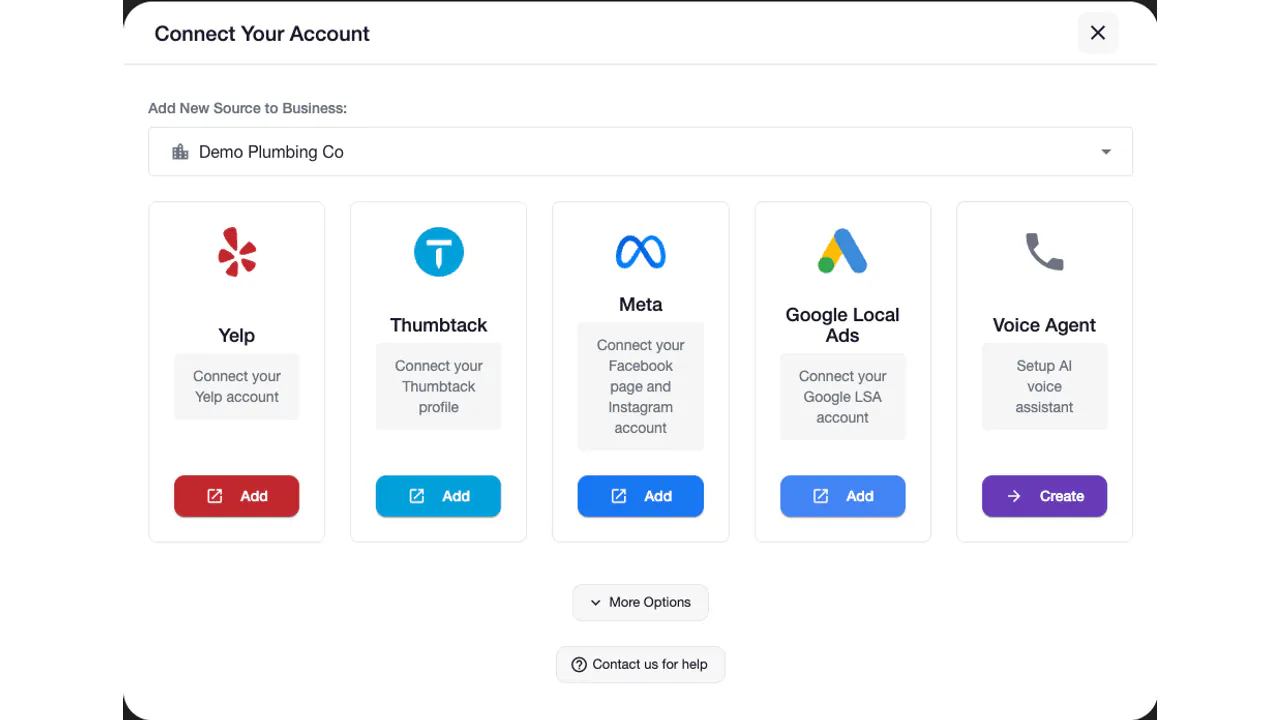
Point your business number at the AI voice agent and authorize the lead channels you sell on. No new phone hardware required.
Paste in your services, pricing ranges, service area, hours, and emergency policy. The AI grounds every answer in this data so it never makes up a price or a coverage area.
Tell the AI what to ask on each job type - service needed, location, timeline, budget range - so it qualifies instead of just taking a message.
Connect your calendar so the AI books real availability, and define which calls escalate to your cell: high-value jobs, emergencies, explicit caller requests.
The next call or lead that lands is answered, qualified, and booked automatically. Watch the first few in your dashboard, tune anything that feels off, leave it running.
Clarity for your team
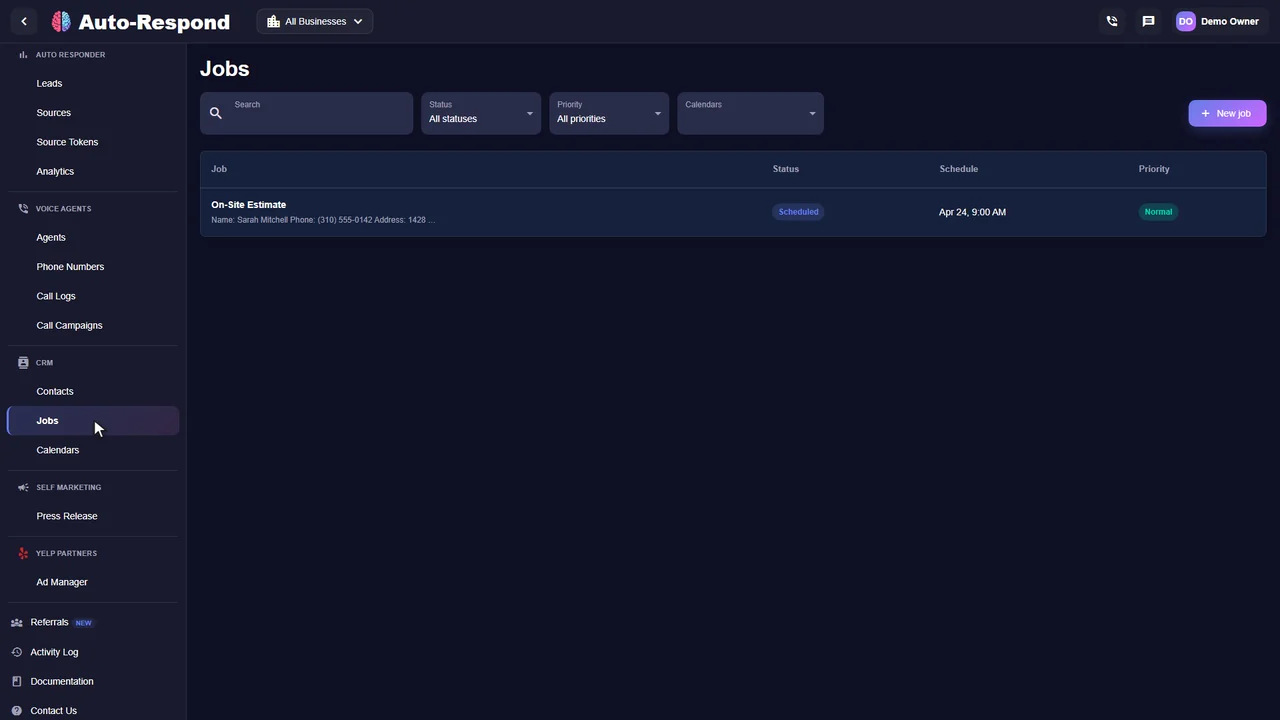
Each call is logged with the recording, transcript, AI summary and the customer details it collected, so you can call back the jobs that matter first. These are real product screens from our demo business.
Know the price before you start
Auto-Respond charges $10 a month for each phone number plus $1 per minute of talk time, for inbound and outbound calls alike, with no contract or setup fee. Message channels such as Yelp or Thumbtack are priced separately; every price is on the pricing page, and our guide to AI receptionist and answering service costs compares the common price models.
AI answering service
Plus $1 per minute of talk time.
See how it works for your business.
Start my free trial No setup fee. No long-term contract.A few things you might be wondering
What business owners ask before they forward their line.
Explore the help centerAn AI answering service answers your business line and runs a natural conversation: what service do you need, where are you, and how soon. It also supports Yelp, Thumbtack, Facebook, Instagram, and Google LSA. For every Yelp inquiry, the AI creates a job-specific response in under 2 seconds, built from your services, price ranges, and availability.
The same product goes by several names: AI answering service, automated answering service, AI phone answering service, AI receptionist, virtual receptionist or AI voice agent. They all mean software that picks up your business calls, talks with the caller and records what they need. The useful difference is not the name but what it does after hello: take a message, or answer questions, book the job and transfer urgent calls.
Pricing varies by channel, usage, and whether a human handles the call. Auto-Respond publishes each price: $10 a month per voice number plus $1 per minute, $99 a month for Yelp, $99 a month for Thumbtack, $49 a month for Google Local Services Ads, $49 a month for Facebook Messenger, $19 a month for Facebook Lead Ads, and $49 a month for Instagram DMs. Every channel includes a 7-day free trial, with no contract, per-lead fee, lead cap, or setup fee.
Not one you can run a business line on for long. Auto-Respond offers a 7-day free trial to eligible first-time customers when the order summary shows it, so you can try the agent with your own business before you pay. After that it is $10 a month per number plus $1 per minute of talk time.
It depends on what you need the service to do. Human services put a person on the phone, while pricing, qualification, booking, and after-hours coverage vary by provider. An AI answering service works around the clock, asks the qualifying questions that matter for the job, books straight into your calendar, and handles supported text and marketplace leads too. Human services still make sense for live emergency dispatch decisions or complex intake that needs human judgment. For routine service inquiries, AI can answer, qualify, and book without leaving a callback chore.
It is a strong fit for a small business because a solo operator or small crew cannot always stop work to answer the phone. A per-channel AI answering service gives a one-person shop 24/7 coverage without hiring a full-time receptionist, and it can qualify and book routine leads instead of leaving a callback list.
The one that does more than take a message at night. Look for four things: you control the hours it answers, it books the job from your real availability, it transfers true emergencies to whoever is on call, and every call is logged with a transcript you can read in the morning. Our after-hours answering service page covers the night and weekend setup in detail.
The voice agent greets callers with your business name, talks in natural language, and adapts to what the caller says instead of reading a rigid menu. You can hear it during setup and tune the greeting, voice, and qualifying script before it takes a live call.
The AI is configured with escalation rules you set. If a caller has an active emergency, a high-value job, or a question outside what the AI is grounded to answer, the call routes to you with the conversation context attached, or the AI takes a detailed priority message and flags it. You decide the triggers, such as an emergency keyword or an explicit request to speak to the owner. The AI handles routine intake and hands you the calls that need human judgment.
Both. The same system supports phone calls and messaging sources. For Yelp, it generates a tailored reply in under 2 seconds. Thumbtack, Facebook, Instagram, and Google LSA leads get an instant response.
Full setup takes under 2 minutes. You forward your business line to the AI agent, add your services, pricing ranges, service area, and hours, set your qualifying questions, link your calendar, and turn it on. No new phone hardware or code is required. The agent starts answering on the next inbound call.
Four things separate an AI answering service from voicemail. First, does it book appointments or only take messages? Second, does it handle the lead sources you use, including supported phone and marketplace channels? Third, is the pricing tied to the channels you run? Fourth, is it grounded in your real services, pricing, and service area? Score any service against those four questions before you start a trial.
Yes. When a caller qualifies, the AI checks your live calendar availability, offers specific open slots, and confirms the booking once the caller picks one. The appointment lands on your calendar and a confirmation text goes to the lead, all before you would have returned a voicemail. This is the line between an AI answering service and an old answering service: one books the job, the other writes down a name and number for you to chase later.
Your next inquiry could be any minute
Built around your business. Ready when your customers are.