
Speed-to-lead, automated
Lead Response Automation
Every paid lead you let sit for half an hour is a lead a faster competitor is already on the phone with. Auto-Respond texts a new lead in under 2 seconds, has an AI voice agent dialing instantly, and keeps following up on anyone who goes quiet, across Yelp, Thumbtack, Facebook, and Google LSA, from one dashboard.
What is lead response automation?
Lead response automation is software that contacts every new inbound lead the moment they arrive, by text, by phone call, by email, without a human at a keyboard. For service businesses it sits across every channel that produces leads (Yelp, Thumbtack, Facebook Messenger, Facebook Lead Ads, Google LSA, website forms, inbound phone) and runs the same response sequence on every single one.
Three pieces make it work:
Auto-responder
Instant SMS or platform-native message that acknowledges the lead and opens the qualification conversation.
AI voice agent
Outbound call instantly that qualifies the prospect and books the job on the spot.
Follow-up sequences
Multi-step, adaptive cadences that keep working a lead who went quiet on the first touch.
What AI tools help contractors respond to leads faster?
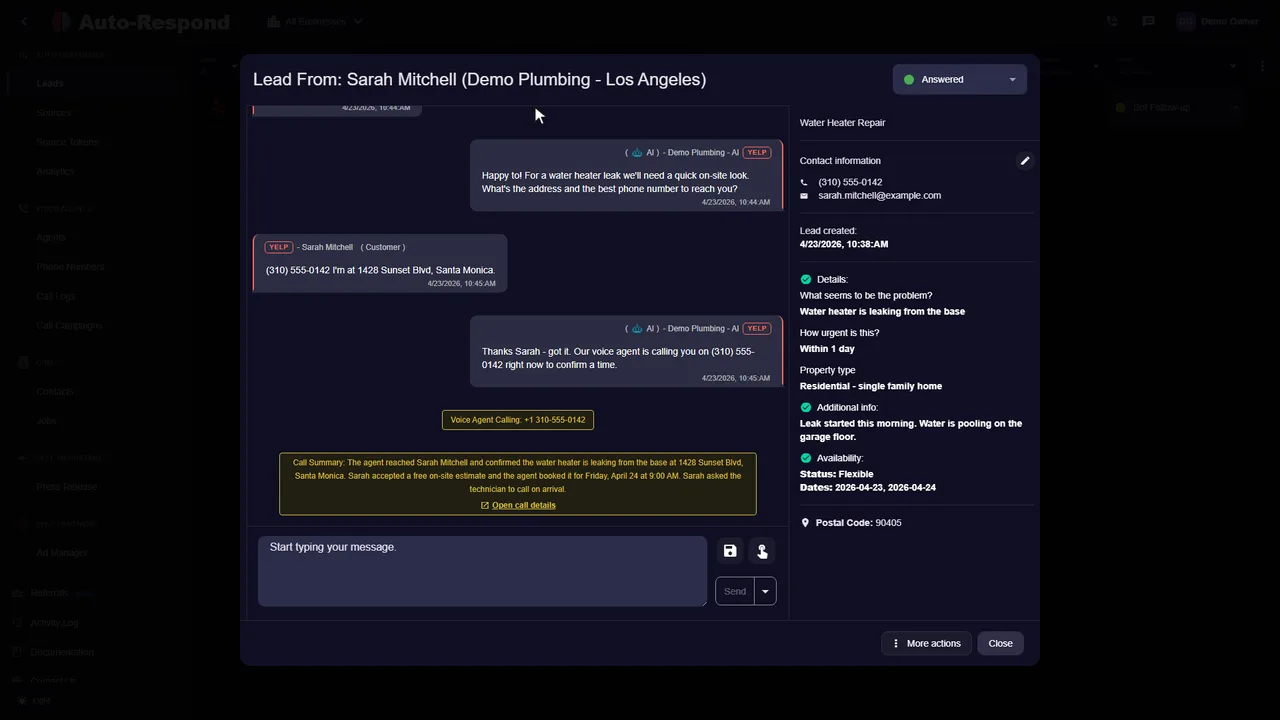
The tools worth paying for share one trait: they act in seconds, not minutes. A useful speed-to-lead stack sends an instant auto-text the moment a lead arrives, places an AI voice call instantly, runs follow-up cadences when the prospect goes silent, and works across every lead channel rather than just your website. Auto-Respond bundles those four into one platform.
Most contractors stitch this together from separate apps: a chatbot for the site, a texting tool, a dialer, a CRM. The handoffs leak. A lead that fills out a Yelp form should not depend on a human noticing a notification, copying a number into a dialer, and remembering to follow up tomorrow. The point of an AI tool here is to remove every place a busy crew can drop the ball. Concretely:
- Instant auto-responder. Texts or platform-messages the lead in under 2 seconds, before they tab over to the next contractor.
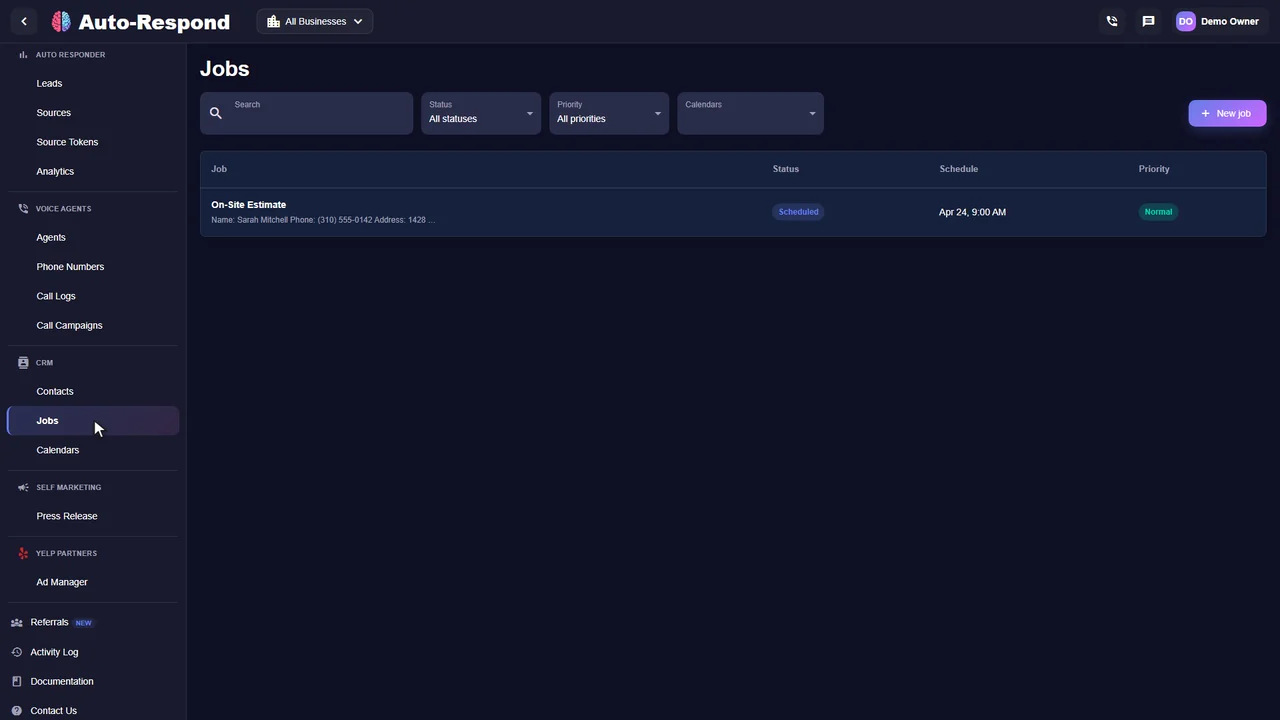
- AI voice agent. Dials the lead, talks like a person, captures the job details, and books straight into your calendar.
- Smart follow-up. Retries by text and voice on a schedule you set, so a no-answer at 9am is not a lost lead by noon.
- One inbox across channels. Yelp, Thumbtack, Facebook, Google LSA, and inbound calls land in the same place with the same speed.
Why speed-to-lead is the variable that decides who wins
This is the most-studied number in sales, and the findings barely move from study to study.
The MIT and MIT Lead Response Management Study (Dr. James Oldroyd) (Dr. James Oldroyd, roughly 15,000 leads) found that contacting a lead within 5 minutes rather than 30 made firms about 100x more likely to make contact and 21x more likely to qualify that lead.
- Harvard Business Review, "The Short Life of Online Sales Leads" (Oldroyd, McElheran, Elkington), studied ~2,200 US companies and found most took hours, even days, to respond, and that firms reaching out within the first hour were several times likelier to have a real conversation.
- The same Harvard Business Review audit of 2,241 U.S. companies found only 37% responded within an hour and 23% never responded at all, with the steepest drop in conversion odds happening in the first minutes.
- Across this body of work, the business that actually connects first usually wins the job.
On Yelp, Thumbtack, and Google LSA your prospect is messaging three or four contractors at once. Whoever actually connects first usually closes before the others even see the lead. You cannot hold sub-5-minute response on every lead by hand, not at 11pm, not during a heat wave, not when your crew is on a roof. The math is what forces automation, not the marketing.
How many leads do you lose after business hours?
More than most owners think. A large share of inbound service leads arrive outside 9-to-5 weekday hours, on nights, early mornings, and weekends. Answered by hand, those leads sit in a queue until morning, by which point most have already hired whoever picked up first. That is a meaningful slice of your paid lead flow quietly leaking out overnight.
The fix is 24/7 lead response: an auto-responder and AI voice agent that treat a 2am burst-pipe inquiry exactly like a 2pm one. The lead gets a text in under 2 seconds, a call instantly, and a booked slot before they move on. No voicemail, no "we'll call you back Monday," no competitor scooping the job while your phone is off. See how speed-to-lead plays out on Yelp and Thumbtack for the channel-by-channel breakdown.
The ROI of cutting your lead response time
The return on faster response is not abstract. It is the same lead spend converting into more booked jobs. Here is the framework, then the worked numbers.
Worked numbers for a contractor running paid Yelp and Thumbtack ads. These are illustrative figures, not measured results. Assume 100 leads a month at $40 cost-per-lead, a 15% booking rate at 30-minute response lifting to 25% at faster response, and a $400 average job.
| 30-minute response | Under-2-second response | |
|---|---|---|
| Leads | 100 | 100 |
| Lead cost | $4,000 | $4,000 |
| Booking rate | 15% | 25% |
| Booked jobs | 15 | 25 |
| Revenue | $6,000 | $10,000 |
| Cost per booked job | $267 | $160 |
Same lead spend, $4,000 more revenue, lower cost-per-booked-job. The automation pays for itself in the first 2-3 booked jobs of the month.
How Auto-Respond automates lead response
Default flow once a channel is connected. The voice leg is handled by our AI voice agent, which qualifies and books on the call:
- 0 seconds. Lead arrives via webhook (Yelp, Thumbtack, Facebook, Google LSA).
- Under 2 seconds. Auto-responder fires. SMS or platform message acknowledges and asks the first qualifying question.
- Seconds later. AI voice agent dials the prospect. If they pick up, the agent qualifies and books in the same call.
- 2-15 minutes. If voice goes to voicemail, the AI leaves a brief message and queues a retry. SMS conversation continues if the prospect texted back.
- 1 hour, 4 hours, 24 hours. Configurable follow-up SMS sequence if the lead is still cold.
- Live transfer on demand. If the AI hits an escalation trigger (high-value, emergency, explicit request), it warm-transfers to your cell with full context.
Lead response automation vs manual follow-up
| Dimension | Manual follow-up | Auto-Respond |
|---|---|---|
| Time to first response | 30-60+ minutes typical | Under 2 seconds (text), seconds (voice) |
| After-hours coverage | None | 24/7/365 |
| Consistency across leads | Drifts with team load | Identical on every lead |
| Concurrency | 1 lead at a time | Unlimited parallel |
| Monthly cost | $2,500-$4,000 (full-time rep) | $99/mo flat per channel + $1/min voice |
| Booking rate per lead | Baseline | Higher — every lead reached before it cools |
Lead response automation vs alternative approaches
| Option | Pricing model | Channel coverage | Outbound voice? |
|---|---|---|---|
| Generic site chatbot | $30-100/mo flat | Website only | No |
| Per-seat enterprise CRM | $97-297/user/mo | Email + form, voice extra | Add-on, paid extra |
| Flat-rate all-in-one CRM | $300-500/mo | Multi-channel, mixed depth | Often a bolt-on |
| Auto-Respond | $19-99/mo per channel + $1/min voice | Yelp, Thumbtack, Facebook, Google LSA, voice, web | Native, instant outbound |
Lead response automation for HVAC
HVAC lives on demand spikes. A heat dome hits, leads triple, your team hits capacity, and the overflow goes unanswered. Auto-Respond eats the spike: every Yelp, Thumbtack, and Google LSA lead gets the same instant reply whether it is the 3rd lead of the day or the 83rd.
Lead response automation for plumbing
Plumbing emergencies do not wait for office hours, and the homeowner with a flooding bathroom calls the next plumber on the list within five minutes if you do not pick up. Auto-Respond captures the 11pm burst-pipe call your competitor's voicemail loses, so the after-hours emergencies that used to go straight to voicemail become booked jobs instead.
Lead response automation for roofing
Roofing is high-ticket, low-volume — every lead is precious. Automation here is less about volume and more about qualification depth: capturing roof type, age, square footage, insurance status, and timeline before any sales time gets invested. A booked inspection coming out of the AI conversation has a meaningfully higher close rate than a cold lead handed to a sales rep.
Lead response automation for Yelp leads
Yelp Request a Quote leads come with phone numbers attached, and Yelp's own data ties response speed directly to win rate. Auto-Respond fires the moment a Yelp lead drops, the AI voice agent dials instantly, and the prospect usually books before checking the next contractor. The dedicated Yelp auto-responder guide walks through the setup.
Lead response automation for Thumbtack leads
Thumbtack charges per lead, so slow response literally burns money. Auto-Respond replies inside the platform messaging and dials the prospect at the same time: one lead, two parallel channels, far more conversion per dollar of Thumbtack spend. See the Thumbtack auto-responder walkthrough for the channel specifics.
Lead response automation for Facebook and Google LSA
Facebook Lead Ads cool fast because the prospect was scrolling, not searching with intent. Google LSA leads are intent-rich but volume-heavy. Both reward fast, consistent response. Auto-Respond handles both with the same automation stack — instant message, AI voice dial, follow-up sequence.
Pricing
- $99/month — Yelp lead automation
- $99/month — Thumbtack lead automation
- $49/month — Facebook Messenger automation
- $19/month — Facebook Lead Ads automation
- $10/month per voice agent phone number
- $1/minute for actual voice call time
- 7-day free trial includes everything
Worked example: contractor running Yelp + Thumbtack + Facebook Messenger plus voice agent on 90 calls/month: ~$330/month all-in.
How to set up lead response automation
- List your lead channels. Note current first-response time on each.
- Sign up at app.auto-respond.com.
- Connect channels via OAuth. One click each.
- Paste in your knowledge base. Services, pricing, hours, qualifying criteria.
- Configure response sequences per channel. Instant text, voice dial, follow-up cadence.
- Connect calendar and CRM.
- Test every channel.
- Go live and monitor week one.
What separates real lead response automation from marketing
- Sub-1-minute first response across every channel. Anything slower defeats the point.
- Native voice and text in one platform. Bolted-on voice add-ons rarely fire fast enough.
- Multi-channel coverage out of the box. Yelp, Thumbtack, Facebook, Google LSA at minimum.
- Knowledge base grounding. Responses must reference your actual services and pricing.
- Configurable follow-up cadences. Different leads warrant different rhythms.
- CRM and calendar integration. Sync, not export.
- Live transfer with context. Escalation should never feel like a cold drop.
Frequently asked questions
What AI tools help contractors respond to leads faster?
The tools that move the needle do three things in one place: send an instant text the second a lead arrives, place an AI voice call instantly, and keep following up if the prospect goes quiet. Auto-Respond runs all three across Yelp, Thumbtack, Facebook, and Google LSA, so no lead waits while interest cools.
What is lead response automation?
Lead response automation is software that contacts new inbound leads automatically, by text, email, and voice, the instant they arrive. It replaces or augments manual follow-up so no Yelp, Thumbtack, Facebook, or Google LSA lead waits in a queue while their interest cools.
How many leads do you lose after business hours?
A lot. A large share of inbound service leads land outside 9-to-5 weekday hours: nights, early mornings, weekends. If you answer manually, those leads sit until the next morning, by which point most have already hired whoever picked up first. Automated 24/7 response treats a 2am lead exactly like a 2pm one.
Why does response speed matter so much?
The MIT and MIT Lead Response Management Study (Dr. James Oldroyd) found that contacting a lead within 5 minutes instead of 30 makes you about 100 times more likely to reach them and 21 times more likely to qualify them. The contractor who actually connects first usually wins the job, almost regardless of price or reviews.
What ROI do you get from reducing lead response time with automation?
It comes from booking more of the leads you already pay for. Take 100 paid leads a month: lifting your booked rate from 15% to 25% turns 15 jobs into 25. At a $400 average job that is $4,000 of extra revenue on the same ad spend, while your cost per booked job drops. Automation that costs a few hundred a month usually pays for itself in the first two or three jobs.
How fast can Auto-Respond contact a new lead?
SMS or platform message fires in under 2 seconds. AI voice dial happens instantly. Compare to manual response averaging 30 to 60+ minutes for most service businesses.
Does it provide 24/7 lead response?
Yes. The auto-responder and AI voice agent run around the clock, every day. Overnight, weekend, and holiday leads get the same instant text, voice call, and qualified booking as a Tuesday-afternoon lead. Nothing waits for someone to clock in.
Which lead channels does Auto-Respond automate?
Yelp Request a Quote and messaging, Thumbtack messaging, Facebook Messenger, Facebook Lead Ads, Instagram, Google LSA leads, plus inbound calls to your business phone, plus website lead forms.
Will the automation actually book more jobs?
Yes. Service businesses moving from manual follow-up to Auto-Respond book more of the leads they already pay for. The lift comes from under-2-second first contact and consistent qualification on every lead, not from any one trick, so the same ad spend turns into more booked jobs.
How is this different from a generic auto-reply?
A generic auto-reply sends one canned "thanks, we will be in touch" message. Lead response automation runs a multi-step adaptive sequence: instant SMS, AI voice dial, follow-up SMS at intervals, retry voice, escalation to your phone, each step branching on what the prospect does next, all referenced against your knowledge base.
Can the AI qualify leads before booking?
Yes. Configure qualifying questions (service needed, address, urgency, budget signals, ICP fit). Leads that pass go directly into your calendar; leads that fail get a polite decline or a routing rule to a different intake flow.
What does Auto-Respond cost?
Per-channel: $99/mo Yelp, $99/mo Thumbtack, $49/mo Facebook Messenger, $19/mo Facebook Lead Ads. Plus $10/mo per voice agent number and $1/min for actual call time. A multi-platform contractor typically spends $200 to 350/month all-in.
Can it integrate with my CRM?
Yes. Native integrations with major service-business CRMs and dispatch platforms. Every lead, conversation, and booking syncs both directions.
How long until I see results?
Most Auto-Respond customers see meaningful conversion lift within the first 30 days, because first-response time on every lead drops from 30+ minutes to under 2 seconds the day automation goes live.
How do I get started?
Sign up at app.auto-respond.com, connect your first lead channel via OAuth, paste in your services and pricing, and the auto-responder is live within 20 minutes. Voice agent adds another 5 to 10 minutes for number provisioning.
Related guides
Deeper reading on speed-to-lead and follow-up tactics:
Hit under-2-second speed-to-lead today
Pick the leads your competitors are too slow to answer. Connect your first channel and Auto-Respond is texting and calling new leads in under 20 minutes.
Start your 7-day free trial